
Some Trigonometric Equations
Summary
\[\displaylines{\begin{align}\sin^2x+\cos^2x =1\\1+\cot^2x =\csc^2x\\\tan^2x+1 =\sec^2x\\\sin(a\pm b) =\sin a\cos b\pm\sin b\cos a\\\cos(a\pm b) =\cos a\cos b\mp\sin a\sin b\\\tan(a\pm b) =\frac{\tan a\pm\tan b}{1\mp\tan a\tan b}\\\sin(2x) =2\sin x\cos x\\\cos(2x) =\cos^2x-\sin^2x\\\cos(2x) =2\cos^2x-1\\\cos(2x) =1-2\sin^2x\\\tan(2x) =\frac2{\cot x-\tan x}\\\cos\frac x2 =\pm\sqrt\frac{1+\cos x}2\\\sin\frac x2 =\pm\sqrt\frac{1-\cos x}2\\\tan\frac x2 =\pm\sqrt\frac{1-\cos x}{1+\cos x}\\\tan\frac x2 =\frac{\sin x}{1+\cos x}\\\tan \frac x2 =\frac{1-\cos x}{\sin x}\end{align}}\]Each of those will be discussed below.
Pythagorean Identities
\[\sin^2x+\cos^2x=1\]Very elegant formula. Think about it in the context of the unit circle where \(x^2+y^2=1\).
From this identity, two more came:
\[\displaylines{1+\cot^2x=\csc^2x\\\tan^2x+1=\sec^2x}\]Proof:
Divide both sides of the first identity by \(\sin^2x\) and \(\cos^2x\), respectively.
Angle Sum/Difference
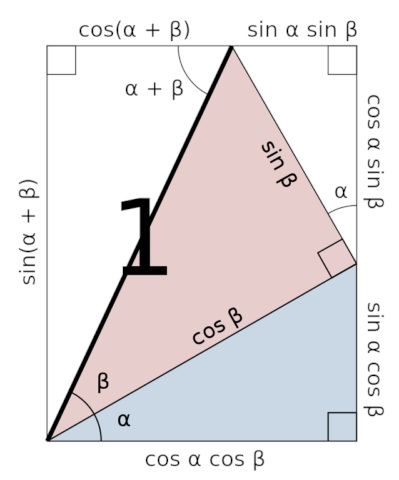
\[\displaylines{\sin(a\pm b)=\sin a\cos b\pm\sin b\cos a\\\cos(a\pm b)=\cos a\cos b\mp\sin a\sin b}\]Proof:
This image from Wikipedia should be self-explanatory.
\[\tan(a\pm b)=\frac{\tan a\pm\tan b}{1\mp\tan a\tan b}\]
Proof:
\[\displaylines{\begin{align}\tan(a\pm b) =\frac{\sin(a\pm b)}{\cos(a\pm b)}\\ =\frac{(\sin a\cos b\pm\sin b\cos a)(\frac1{\cos a\cos b})}{(\cos a\cos b\mp\sin a\sin b)(\frac1{\cos a\cos b})}\\ =\frac{\frac{\sin a}{\cos a}\pm\frac{\sin b}{\cos b}}{1\mp\frac{\sin a\sin b}{\cos a\cos b}}\\ =\frac{\tan a\pm\tan b}{1\mp\tan a\tan b}\end{align}}\]Double Angle
\[\displaylines{\begin{align}\sin(2x) =2\sin x\cos x\\\cos(2x) =\cos^2x-\sin^2x\\\tan(2x) =\frac2{\cot x-\tan x}\end{align}}\]Proof:
Expand the Angle Sum formulae above for \(a=x\) and \(b=x\) to get this formula.
\[\cos(2x)=2\cos^2x-1=1-2\sin^2x\]
Proof:
Use the Pythagorean Identity and the cosine Double Angle identity above.
Half Angle
\[\displaylines{\cos\frac x2=\pm\sqrt\frac{1+\cos x}2\\\sin\frac x2=\pm\sqrt\frac{1-\cos x}2}\]Where the sign before the square root varies based on the value of \(x\) (you should be able to figure that out!).
Proof:
\[\displaylines{\cos(2x)=2\cos^2x-1\\\cos x=2\cos^2\frac x2-1\\1+\cos x=2\cos^2\frac x2\\\frac{1+\cos x}2=\cos^2\frac x2\\\cos\frac x2=\pm\sqrt\frac{1+\cos x}2}\]And
\[\displaylines{\cos(2x)=1-2\sin^2x\\\cos x=1-2\sin^2\frac x2\\1-\cos x=2\sin^2\frac x2\\\frac{1-\cos x}2=\sin^2\frac x2\\\sin\frac x2=\pm\sqrt\frac{1-\cos x}2}\]\[\tan\frac x2=\pm\sqrt\frac{1-\cos x}{1+\cos x}\]
Proof:
Should be straightforward given the above two Half Angle identities and that \(\tan x=\frac{\sin x}{\cos x}\).
\[\tan\frac x2=\frac{\sin x}{1+\cos x}=\frac{1-\cos x}{\sin x}\]
Proof:
Multiply both the numerator and the denominator of the previous tangent Half Angle identity by \(1+\cos x\) and \(1-\cos x\), respectively, and use the Pythagorean identities.
References
Wikipedia, List of trigonometric identities, https://en.wikipedia.org/wiki/List_of_trigonometric_identities
Wikipedia, Proofs of trigonometric identities, https://en.wikipedia.org/wiki/Proofs_of_trigonometric_identities